
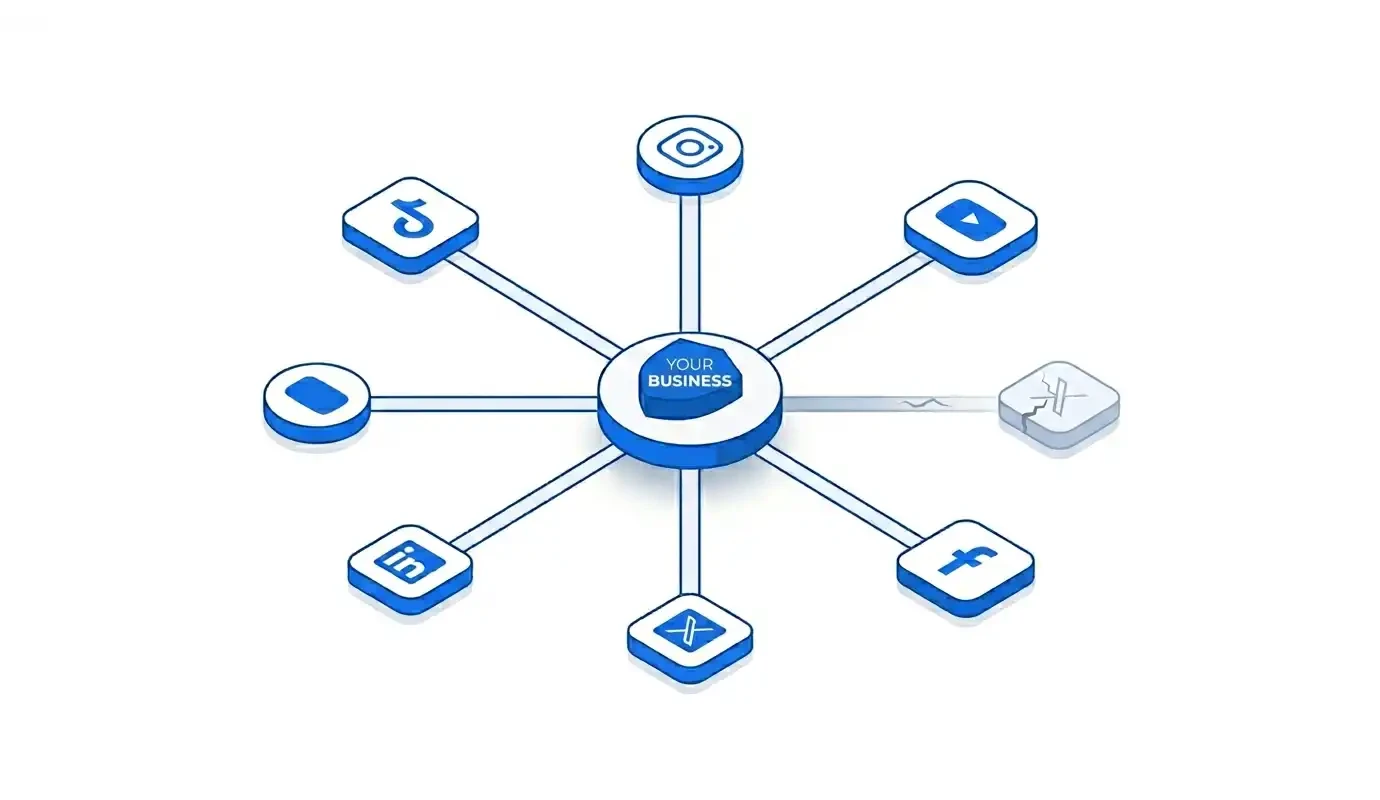
Sarah's DTC skincare brand had 400,000 TikTok followers. For 18 months, organic traffic drove 40% of her revenue. Her team filmed content, rode trends, and built a community that actually bought products. Then, one Tuesday morning, her reach dropped 60%. No warning. No explanation. No appeal. An algorithm update had reshuffled the feed, and her content—content that had performed consistently for a year and a half—simply stopped being seen.
The team panicked. They poured money into ads to compensate. They posted more frequently, chasing the old engagement levels. Nothing worked. Sarah had built her entire audience on someone else's land, and the landlord had changed the lease terms overnight.
Meanwhile, a competitor running a parallel strategy saw the same TikTok dip—about 15%. Barely a blip. They were active on Instagram Reels, YouTube Shorts, and LinkedIn. Their overall traffic held steady because no single platform controlled their audience. They had what Sarah didn't: Algorithm Insurance.
Algorithm Insurance is the practice of treating your multi-platform presence not as a growth hack for ambitious brands, but as fundamental risk management. An omni-channel social media strategy protects your revenue, visibility, and audience relationships from forces you cannot control—algorithm shifts, policy changes, platform instability, and audience migration.
The Critical Question
If your primary platform disappeared tomorrow, would your audience know where else to find you?
Most businesses can't answer that question honestly. And that silence is the sound of uninsurable risk.
The Hidden Risk of Single-Platform Dependency
Building your entire social presence on one platform is structurally dangerous. Not because you're lazy. Not because you're naive. Because the platform business model is designed to extract value from your attention, not to protect your business.
There are three risk vectors that make single-platform dependency a ticking problem:
Algorithm Volatility
Organic reach is not a right. It is a loan, and the terms change without notice. Platforms adjust their algorithms constantly—often to push creators toward paid advertising. Instagram's pivot from photos to Reels punished photo-only creators who had spent years optimizing for a format that was suddenly deprioritized. Facebook's organic reach collapsed from roughly 16% in 2012 to under 5% by the early 2020s. TikTok's uncertain legislative future in the US has left millions of businesses wondering if their primary marketing channel will simply cease to exist in their market.
Platform Instability
Beyond algorithms, there are policy changes, account bans, shadow banning, outages, and regulatory intervention. An account that violates a terms-of-service update—intentionally or not—can lose years of audience-building overnight. No appeal process guarantees restoration. No customer service line saves your quarterly revenue. The platform owns the relationship with your audience. You are a tenant.
Audience Migration
People shift platforms constantly. Vine died, and its creators scrambled to Instagram. MySpace evaporated, and its audience moved to Facebook. Snapchat's dominance among younger users fractured when TikTok arrived. The audience you built on today's dominant platform will follow the next cultural shift to somewhere you may not be present. Brands that only follow one migration path lose ground in the next one.
Think of it this way: a single-platform strategy is like a restaurant with one supplier. The moment that supplier faces a disruption—a price spike, a recall, a shutdown—your entire operation is exposed. Omni-channel isn't greed. It's survival planning.
This isn't about fear. It's about building a business that survives the conditions it cannot control.
Why Smart Brands Diversify: The Business Case for Omni-Channel
If risk management were the only argument, omni-channel would be a defensive strategy. But diversification is also offensive. It expands your reach, deepens your authority, and accelerates trust. Here's the business case in three pillars:
Pillar 1 — Audience Reach Is Fragmented by Design
Different demographics live on different platforms. More importantly, the same person behaves differently depending on where they are. The millennial professional scrolling LinkedIn at 8am is not the same person laughing at TikTok at 11pm. Being present across ecosystems means reaching your audience in the context where they are most receptive—not just where you happen to be most comfortable.
Map your platforms by role:
- TikTok → Discovery and entertainment; cold audience acquisition
- Instagram → Community, lifestyle, engagement; warm audience nurturing
- YouTube Shorts → Evergreen, searchable content; long-term discoverability
- LinkedIn → Thought leadership, B2B authority, professional trust
- Facebook → Groups, communities, older demographics
- X (Twitter) → Real-time conversation, industry commentary
Each platform serves a different function in your buyer's journey. Ignoring any of them means leaving money on the table.
Pillar 2 — Cross-Platform Presence Creates a Virtuous Cycle
Platforms often algorithmically reward creators who bring external traffic. A YouTube video that drives viewers to your Instagram boosts authority signals on both platforms. A LinkedIn post that links to your YouTube Shorts creates cross-pollination that compounds discoverability over time. This "omnipresence effect" accelerates the buyer's journey—people who encounter your brand across multiple touchpoints move from awareness to trust significantly faster than those who see you once.
Pillar 3 — You Don't Own a Rented Audience
An email list is yours. A website is yours. A TikTok following belongs to TikTok. Social media risk management isn't just about surviving platform failure—it's about gradually moving rented audiences toward owned channels. The more touchpoints you control, the less vulnerable you are to any single landlord changing the terms.
The Consistency Paradox
Here's the objection I hear most often: "If every platform has a completely different culture, how do I maintain a coherent brand without creating 8x the work?"
The answer is Adaptive Consistency: your core brand identity—values, tone, visual language, key messaging, personality—remains fixed, while the expression of that identity adapts to the native format of each platform.
Consider a fitness brand. Same company. Same mission. Same voice. Four different containers:
- TikTok: 15-second transformation clips using trending audio. High energy. Rapid cuts. Creator-native format.
- LinkedIn: A 300-word founder post on the connection between discipline and entrepreneurship. Same brand tagline. Same colors. Completely different container.
- YouTube Shorts: A 45-second educational tip with the same host, the same visual identity, but framed as searchable how-to content.
- Instagram: A polished carousel breaking down a workout myth. High-production aesthetic. Community-focused caption.
Same brand. Same voice. Same values. Four completely different containers.
To make this repeatable, use the 3 Cs Framework:
Core Message
What stays the same: Your brand values, visual identity, key messaging, tone personality
Container
What changes: Format, length, aspect ratio, caption style, native features per platform
Cadence
When and how often: Platform-specific posting frequency optimized for each algorithm
Adapting your container is not compromising your brand. It is respecting your audience enough to meet them where they already are.
"Being everywhere doesn't mean doing everything. It means being strategic about where you show up."
The Efficiency Myth: Why "Managing 8 Platforms" Sounds Worse Than It Is
Let's be honest about the operational pain. The old workflow was genuinely exhausting:
Log into TikTok. Export the clip. Re-edit for Instagram's 9:16 ratio. Rewrite the caption—different character count, different hashtag strategy, different CTA. Log into YouTube Studio. Re-upload. Reformat the thumbnail. Switch to LinkedIn. Rewrite the entire post in professional language. Manually schedule each one in each platform's native scheduler. Check analytics across five separate dashboards. Repeat tomorrow.
This did require multiplying your workload. For individual creators or lean marketing teams, it was unsustainable. And that unsustainability became the excuse for staying single-platform.
But modern unified publishing tools have fundamentally changed this equation.
Posting Suite is the operational answer to the structural problem just described. It is not a shortcut. It is the system that separates strategic brands from exhausted social media managers.
Here's how the Across 8+ Platforms capability works in practice:
You input your core asset and message once into a single dashboard. The tool formats natively for each platform's requirements—aspect ratios, caption character limits, hashtag best practices, optimal scheduling windows. All platform variations are visible side-by-side before publishing, allowing a brand manager to apply the Adaptive Consistency framework at a glance. Analytics are centralized, so performance across all channels feeds into one view.
Cross-platform visibility does not require cross-platform complexity. This isn't just a time-saving feature. It is what makes an omni-channel strategy operationally viable for teams that don't have a 10-person social department. It removes the legitimate barrier that has kept smart businesses from protecting themselves.
Your Starter Playbook: Getting Started in 30 Days
If you're currently operating on a single platform, here is your exact next month:
Pull your analytics from the last 90 days. Identify 5–10 pieces of "evergreen winner" content—posts that over-performed in reach, saves, shares, or conversions. These are your redistribution candidates. Do not create new content yet. Work with what has already proven itself.
Map Your Secondary Platforms (Days 3–5)
Based on your primary platform and target audience demographics, identify your top 3 secondary platforms. If TikTok is primary, add YouTube Shorts for searchability and long-term discoverability, and Instagram for community depth. If LinkedIn is primary, add YouTube for authority content and X for real-time conversation. Be strategic, not scattered.
Repurpose, Don't Recreate (Days 5–14)
Apply the Adaptive Consistency framework to your evergreen winners. Take proven assets and re-express them in the native format of each new platform. One piece of content. Three platforms. Three containers. This is content repurposing at its most disciplined.
Establish a 30-Day Test Cadence (Days 14–30)
Use a unified posting tool to schedule your redistributed content across all platforms simultaneously. Track which secondary platform delivers the most meaningful "insurance reach"—engagement, follows, or traffic—relative to your primary channel. This is your multi-channel content strategy in motion.
Review and Double Down
At day 30, identify which secondary platform gained the most traction. Increase cadence there. Do not abandon your primary channel. The goal is to add resilience, not dilute focus. You are building social media diversification, not chaos.
A Smarter Strategy for 2026 and Beyond
Smart businesses do not attempt to predict which platform will dominate next year. They position themselves to remain visible regardless of which platform shifts, grows, or collapses.
The brands that survived the Facebook organic decline, the Vine shutdown, and the TikTok uncertainty were not the ones who predicted the change. They were the ones who had already built parallel audiences.
The next wave of social fragmentation is already forming. AI-native platforms, decentralized social networks, and short-form audio are all emerging channels that will compete for your audience's attention. A diversified foundation built today is the only infrastructure that remains relevant through whatever comes next.
The smartest brands don't rely on one platform to survive. They build a presence strong enough to thrive—regardless of which platform changes next.
What to Do Now
Sit with one diagnostic question:
If your primary platform's organic reach dropped 60% tomorrow—would your audience know where else to find you?
If the honest answer is no, that is the gap this article has been addressing.
If managing multiple platforms has felt like a reason to delay building that safety net, Posting Suite removes the operational barrier. One dashboard. Eight platforms. Your brand, consistently visible—wherever your audience happens to be.
Start Building Your Algorithm Insurance Today
Start with your audit. Map your secondary channels. Apply the 3 Cs Framework. And give your business the insurance it should have had all along.
